The Government Statistician, Samuel Kobina Annim has urged stakeholders in teh Water, Sanitation and Hygiene (WASH) sector to accelerate interventions to end the canker of open defaecation by 2030.
Prof. Anim said at the current pace, Ghana’s chances of ending OD by 2030 were minimal unless authorities accelerate interventions.
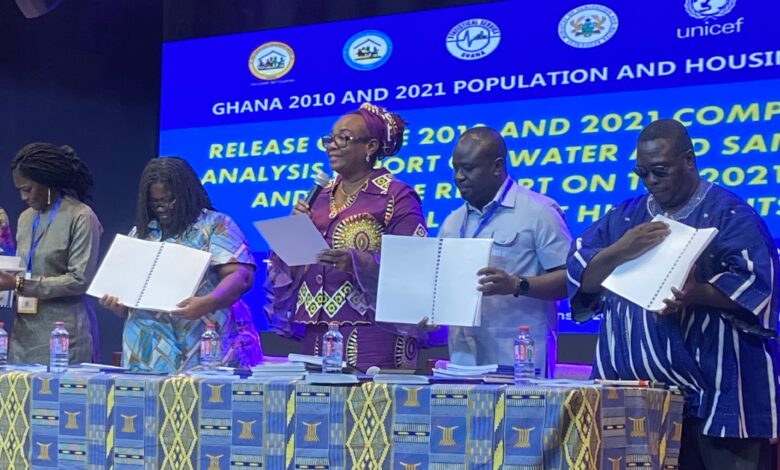
The government statistician said this during the launch of the 2010 and 2021 Comparative Analysis Report on the performance of Water and Sanitation as captured under the 2021 PHC General Report Highlights last Thursday.
The data paints different scenarios, and this is the time we need to accelerate because, if over the 11-year period we have reduced OD by just 1.6 percentage points, and we have seven years to 2030, then clearly, we are not likely to achieve the universal ending of open defecation,” Prof. Annim said.
Although nationally, there have been some improvements in open defecation, the official said “but it is very minimal. The drop in margin is just 1.6 percentage points over the 11-year period.”
He said many districts still lagged, and based on the mantra of leaving no one behind, there is a need to start targeting districts that have retrogressed and are below the national target.
Whilst in some other districts notably the Nandom District and some districts in the Upper West Region, we see improvement in excess of 50 percentage points over the 11-year period”. He explained.
Prof. Annim, urged the Local Government, Decentralization, and Rural Development Ministry to have a breakfast conversation among the District Chief Executives to make those who have seen quite a tremendous improvement over the 11-year period and other districts that have retrogressed to share notes and experiences and strategise for the way forward.
He further called on the Ministry of Sanitation and Water Resources to go back to their own national target for the periods between 2021 to 2030 and revise their statistics.
The Ghana Statistical Service (GSS) report revealed that the proportion of households that use septic tanks increased by 9.6 percentage points between 2010 and 2021, whilst the use of KVIP/VIP also increased by 1.3 percentage points over the same period.
The increase according to the report, is reflected among both urban and rural households except for the use of KVIP/VIP that reduced in urban areas.
Again the proportion of households that use pit latrine reduced from 41.3 percent to 27.1 percent over the same period. This reduction also occurs among urban and rural households, according to the GSS report.
The report says, there is a substantial reduction in the number of households that use bucket/pan latrines from (1.6%) 40,678 in 2010 to (0.1%) 2,576 in 2021.
Reacting to the findings from the report, UNICEF WASH Specialist, Mrs. Loretta Roberts indicated that, even though there is a lot to be done to meet the 2023 deadline, the good news from the data is that the country has made massive strides since 2010.
“So for us, it is an encouragement that we know what to do to ensure that we can meet the target with the right investments, especially within the Metropolitan, Municipal, and Districts Assemblies,” she emphasized.
She was confident that with more hard work, Ghana would be able to meet the SDG targets of eliminating open defecation, and increasing and ensuring that each household has access to WASH facilities for their use. Mrs. Roberts retorted.
“From the data presented today, one could clearly see that at the national level, it seems that there is a marginal reduction, but the challenge is when you go down into details, particularly for the districts, you would see that some districts have done very well by reducing open defecation by more than 50 percent,
“Most of these districts, which have achieved this feat started with social and behaviour change, bolding the capacity of the private sector to be able to support households acquired durable sanitation facilities and then enforcement of by-laws,” The UNICEF WASH Specialist noted,